 English
  Cymraeg
Whitchurch History Cymru
Pub walk
In June 2023 we put together a very popular Pub Walk around a few of Whitchurch's many pubs. You can follow the walk yourself by following the waymarkers below which give you a feeling for the Village's rumbunctious past.
Walk waymarkers
The Fox and Hounds
This area is the oldest part of the ‘village’ with a 4000 year history. It contains Treoda and the old church of St Mary’s. The area was known as the ‘Upper Village’ (‘Treoda Uchaf’). Treoda itself was an ancient mound, believed to be the meeting place of Bronze Age and Iron Age. The area later formed part of a Roman settlement and afterwards returned to Welsh ownership within the lands of the Lordship of Senghennydd.
The earliest known mention of old St Mary’s Church, opposite the pub, is that of a ‘Duchy of Lancaster’ record of 1492. In the 16thC a new church was built and from which the Welsh equivalent name of Eglwys Newydd was derived.
The pub was mentioned in an 1833 abstract which was kept by Thomas Phillips in a small outbuilding referred to as The Fox School. In February 1924 the school room hosted the first mass in Whitchurch since the Reformation.
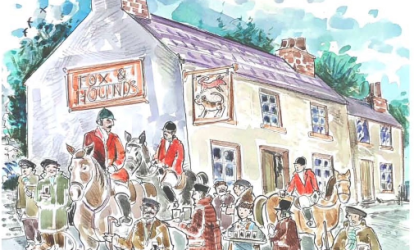
With the construction of the Glamorganshire Canal (1795) and the success of the Melingriffith tin works the area became more and more ‘gentrified’. Some of the larger homes of this area were known to own packs of hounds used for fox hunting. It is believed that the pub got its name from these local hunting events.
The Fox and Hounds became part of the Brain’s business empire in 1908 and to all intents and purposes remained so until the recent takeover by Marsdens a few years ago.
The Plough
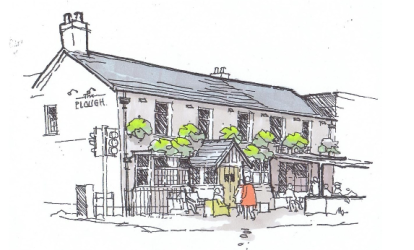
The Plough has been on this site since the middle of the 19th century. The pub and its first landlord are inextricably linked. In the late 1840s, Reuben Lewis, a blacksmith was living at the ‘House Building’ on the corner, with his wife, and family. He had a busy smithy, but was also something of an inventor. He designed a ‘novel’ plough and won numerous prizes at local shows. He even exhibited at the Great Exhibition in 1851 and won a prize!
Reuben was probably brewing beer in the house, blacksmithing being a strenuous and thirsty job; and providing beer to his customers too! It’s no surprise then, to learn in 1861 Reuben and his family were living in a public house called ‘The Plough’, almost certainly named after his invention
Later, Reuben built 5 cottages behind the pub. They’re still here today, but now, form part of the pub restaurant and kitchen. Reuben’s story of a successful businessman sadly didn’t last long. He was threatened with bankruptcy culminating with a sale-by-auction in 1864. The lots included the pub, brewhouse, blacksmith’s shop and the 5 cottages
After Reuben, the Plough was taken over by a man called William Williams (his nickname was ‘Bill Twice’)
Through two world wars, the Plough served beer from various brewers, Bass, Hancock’s and latterly Brains. Sadly, there’s no sign of the blacksmiths forge now, but Reuben and his novel plough live on in the name of one of the village’s favourite pubs
The Royal Oak
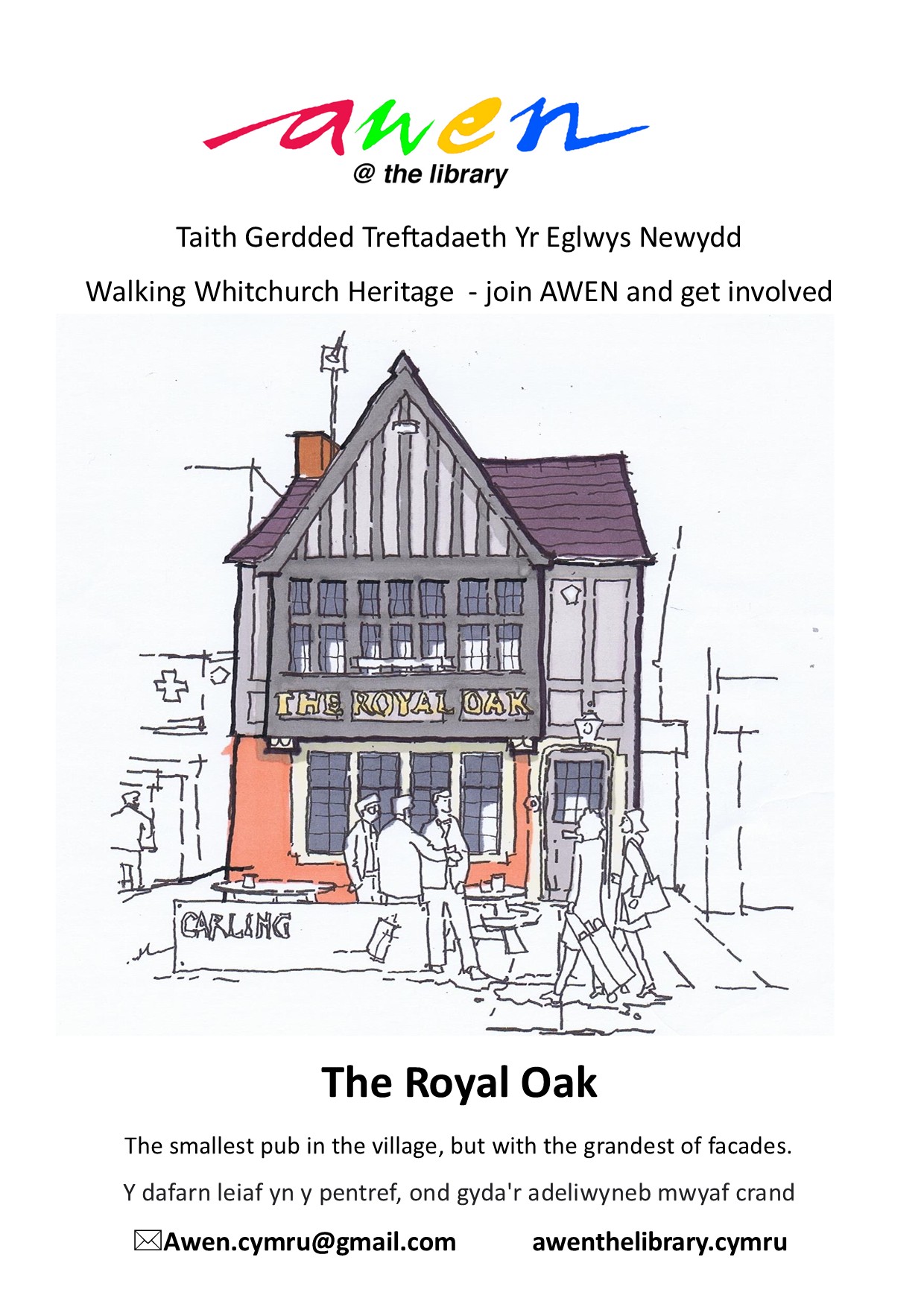
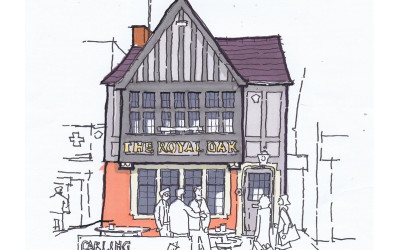
Has this always been the smallest pub in the village? It has just a front room and a back room (and a bar). It was built about 1861 as a simple double-fronted cottage at the end of a long terrace, with the Plough at the other end
By 1877, it had changed to a proper pub, with George Roberts as landlord. That year he was in trouble with the Licensing Bench
Pubs closed on a Sunday, but the Wales Sunday Closing Act allowed bona fide travellers to eat or drink in a public house, provided that they lived at least three miles away. There are lovely stories in the newspapers of the time, of the police recognising drinkers who lived just a few houses away!
On Sunday 17th January 1895 for example, the Royal Oak had 50 drinkers early in the evening; a day when the pub was officially closed! The rear room of the Royal Oak was known for hosting meetings. The nobs and crachach of local society were often found in there
Between the world wars, a flat-roofed chemists’ shop (Ducks) was built in the front garden, with only half of the original pub left visible to the road. By the early 1950s, Boots the Chemist were trading there, still in the tiny shop
It was probably in the 1950s that the Royal Oak received its new appearance with towering gable, lead-light windows and stone surrounds
By the 1970s everything had changed. The little shop was gone, Boots the Chemist had doubled in size next door and all of the little cottages had been demolished, replaced by bigger shops
So, what’s next for the Royal Oak? The pub has a new landlady, and she is very keen on becoming more involved in community life. In the meantime, let’s just enjoy the pub as a quirky insert to our village
The Maltsters Arms
The Maltsters we see today was probably built in the latter part of the 19th century, but there are references to a much older pub. Where was it? There are no photographs to help, but there’s a lovely story to tell though:
The Tithe Map shows that there wasn’t much around. There was the old road, a block of ancient thatched cottages, and what looks like an agricultural building running alongside the road. Nothing else!
The notes accompanying the tithe map lists Hannah Johnson as tenant of ‘The Malthouse’. Where was this? The Census gives no clues, but by 1851, Hannah Johnson is listed as a widow/publican, living in the Maltsters Arms. A change in name, but where was the pub?
Two years later, a newspaper article advised that Hannah Evans was now the publican. She had a grand ‘housewarming’ to celebrate, with the event held in a flower-bedecked marquee in the side garden with 120 guests in attendance. What if the old thatched cottage (that we see as a draper’s shop in the old photograph) was the original pub?
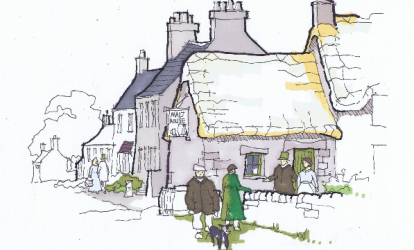
The sketch imagines the area about 1850, with the single-storey thatched cottage as ‘the Malthouse’ with 2 cottages just behind and a further 5 cottages beyond. It’s not too hard to imagine the old stone walls, small timber windows and a plank door to a pub. There’s a stone garden wall and an unmade road; very rural. It was probably 15 years later that a new pub was built within the side garden, reusing the name ‘Maltsters Arms’. The old pub wasn’t demolished, but later converted into a draper’s shop
By 1865 Mary Phillips was landlady, and by 1877 Mr and Mrs Brinn were the landlords, probably in the new pub
This story is complete speculation, but there’s more than a hint of truth. What do you think?